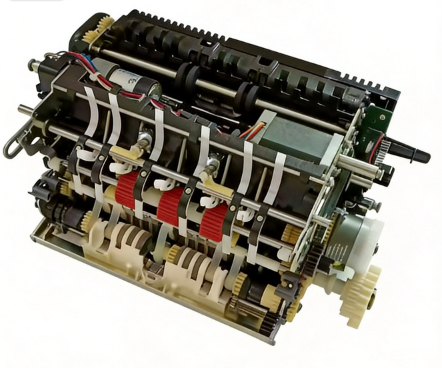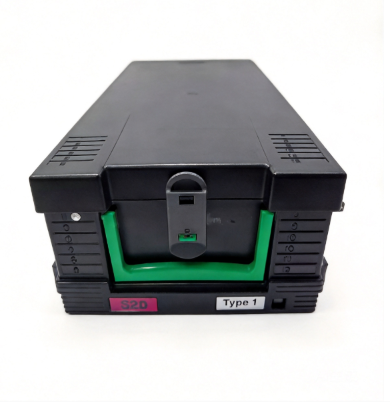
When an ATM goes down, everybody blames the cash dispenser or the card reader first. Fair enough — those are the obvious suspects. But in a surprising number of cases, the real villain is a twenty-dollar sensor that quietly failed and took a twenty-thousand-dollar machine offline with it.
ATM systems depend on dozens of sensors working in concert. They detect cassette positions, monitor motor speeds, measure temperatures, and verify every banknote that passes through the transport path. If you know what these sensors do — and which ones tend to fail — you can save your service operation thousands of dollars in downtime and unnecessary part swaps.
This guide walks through five critical sensor types found in modern ATMs, what their failure looks like in the field, and what to watch for when sourcing replacements.
Proximity Switches
Where you'll find them: cassette bays, shutter doors, service panels, transport path gates.
What they do: detect whether a component is sitting in the right position — cassette fully seated, shutter open or closed, access door secured.
There are four types commonly used in ATMs. Inductive switches detect metal objects within one to ten millimeters — these are your go-to for cassette presence detection and metal gate position sensing. Capacitive switches detect any material, making them useful for note presence in the transport path. Photoelectric switches work on beam interruption and handle note counting and paper path monitoring. Micro-switches are plain mechanical contacts, used for door interlocks and service panel security.
When a proximity switch starts failing, you'll typically see "Cassette Not Detected" errors even though the cassette is pushed all the way in. Or the shutter will work intermittently. Or the machine will refuse to start with a persistent "Door Open" error when every door is visibly closed. Dust buildup on photoelectric sensors is especially common — it shows up as repeated note jam errors that have nothing to do with an actual jam.
For replacement, four things matter. Match the sensing distance — one millimeter versus five makes a real difference in whether the sensor triggers reliably. Check the output type: NPN and PNP use different wiring, and they are not interchangeable. Verify the operating voltage — most ATM sensors run on DC 24V. And pay attention to the IP rating: sensors in the transport path need minimum IP65 for dust resistance.
Encoders (Rotary and Linear)
Where you'll find them: CDU dispensing shaft, cash acceptor motor shafts, transport rollers.
What they do: provide precise angular or linear position feedback. The CDU's dispensing motor relies on the encoder to know exactly how far the pick roller has rotated. Miss one pulse and you've got a miscount.
Optical incremental encoders are the standard for CDU motor feedback, ranging from 100 to 5000 PPR depending on the model. Magnetic encoders typically handle cash acceptor rollers at 64 to 1024 PPR. Absolute encoders (single-turn or multi-turn) are used for shutter positioning where you need to know the position even after a power loss.
Failure symptoms are usually pretty clear: miscounted banknotes where the CDU dispenses the wrong amount, "Encoder Error" or "Position Error" in the diagnostics log, a motor that runs but dispenses erratically, or intermittent failures caused by a dirty encoder disk.
When replacing an encoder, the PPR must match exactly. Going from 500 PPR to 1000 PPR will cause the controller to over-count and dispense double the notes. Check whether the output is differential (A, B, Z channels) or single-ended — the controller won't read a mismatched signal type. Shaft diameter and mounting pattern are brand-specific, so don't assume compatibility just because the housing looks the same. And before you order a replacement, try cleaning the encoder disk — accumulated dust is far and away the number one cause of encoder errors in the field.
Hall Effect and Magnetic Speed Sensors
Where you'll find them: CDU motor shafts, transport belt pulleys, fan assemblies.
What they do: measure rotational speed without any physical contact. A Hall sensor detects passing gear teeth or changing magnetic poles and outputs a pulse train proportional to RPM.
The CDU firmware monitors motor speed in real time. If speed drifts more than about five percent from the expected range, the controller flags a fault. A failing speed sensor can trigger false "motor stall" errors even when the motor itself is perfectly fine.
Typical specs to know: operating voltage runs DC 5 to 24V. Output is usually open-collector NPN with a pulse train. The sensing gap is tiny — just 0.2 to 2.0 millimeters. Frequency range covers zero to 20 kHz. These things are tough, with a rated temperature range of minus forty to plus 125 degrees Celsius.
When one fails, you'll see "Motor Speed Error" while the motor runs normally, erratic RPM readings in diagnostics, dispensing failures that only happen at certain speeds, or a complete dispensing failure with no motor error code at all — that last one usually means an open-circuit sensor.
Temperature Sensors
Where you'll find them: power supply compartment, CPU board area, thermal printer, sealed cash safe.
What they do: prevent overheating. Outdoor and semi-outdoor ATMs — drive-through units, kiosk machines — deal with serious temperature swings. Overheating degrades thermal printer output, causes CPU throttling, and in extreme cases triggers an automatic shutdown that takes the machine completely offline.
ATM temperature sensing uses a few different technologies. Pt100 RTD sensors are the precision option, covering minus 200 to plus 850 degrees Celsius with accuracy down to a tenth of a degree in Class AA. LM35 analog sensors handle general monitoring from minus 55 to plus 150 with about half a degree of accuracy. Type K thermocouples monitor the power supply at up to 1250 degrees — rough accuracy at about two degrees, but they survive where other sensors would melt. Digital DS18B20 sensors are popular for multi-point monitoring setups, covering minus 55 to plus 125 with half-degree accuracy.
Look for these failure patterns: the machine shuts down only in hot weather and runs fine otherwise, thermal printer output fades when temperatures climb, "Temperature Warning" entries in the system log, or false overheat shutdowns caused by sensor drift — the sensor reads several degrees higher than actual and the controller acts on bad data.
Photoelectric and Fiber Optic Sensors
Where you'll find them: note transport path, cassette exit slot, stacker mechanism.
What they do: count notes, detect doubles, verify note position. These are the fastest sensors in the machine, with response times under 250 microseconds — fast enough to handle notes flying through at over ten per second.
Key specs that matter: response time under 250 microseconds is non-negotiable for counting at dispensing speed. Detection distance is typically three to thirty millimeters, set by transport path clearance. Light source is either red LED or infrared — different note colors and materials need different wavelengths for reliable detection. Output type is NPN or PNP, with light-on or dark-on selectable to match the controller's input logic.
Common failures: double-note detection stops catching doubles, note counting runs over or under consistently, frequent "Note Jam" errors that trace back to dust on the lens rather than an actual jam, and persistent "Sensor Dirty" warnings. The maintenance rule here is straightforward: clean fiber optic sensor ends with isopropyl alcohol and a lint-free cloth. A large portion of what gets logged as photoelectric sensor failure in the field is just a dirty lens. Always clean first, replace second.
Sensor Cross-Reference by ATM Brand
Every brand has its problem children. Here's what we see most often in the field:
Hyosung MX5600 units tend to eat cassette proximity switches — standard inductive M8, DC 24V, NPN normally open. The Hyosung NH2700 is known for CDU encoder issues, needing an optical 500 PPR unit with a six-millimeter shaft. NCR SelfServ 66xx series runs into transport path photo-sensor problems regularly, using infrared through-beam sensors at around thirty millimeters.
Diebold 429 and 559 models are tough machines, but the door interlock micro-switches are a weak point — SPDT, five amp, roller lever type. The Wincor CMD-V4 has a shutter position sensor that catches people out because they assume it's Hall effect, but it's actually a photoelectric through-beam, and on some configurations a hybrid photosensor.
Quick Troubleshooting Flow
When you get a sensor error, work through it methodically rather than firing the parts cannon.
First question: can you reach the sensor? If yes, clean the sensor face or lens. That alone fixes a surprising number of problems. If you can't access it, start by checking the wiring harness connection — loose connectors are cheap to fix and expensive to ignore.
Cleaned it and still getting the error? Now check supply voltage at the sensor. If voltage is within spec, the sensor itself has likely failed — time to replace it. If there's no voltage at all, trace the wiring back to the controller. The problem may not be the sensor.
Replaced the sensor and still seeing errors? That's when you check the controller input channel. At this point you may be looking at a controller board failure, not a sensor problem at all.
Wrapping Up
Sensors are the nervous system of an ATM. They don't move the money, but without them nothing moves reliably — or at least, not accurately. For anyone running an ATM service operation, keeping a small stock of the most common sensor types pays for itself fast. Proximity switches in M8 and M12, 500 PPR optical encoders, through-beam photo-sensors — these are the ones that fail most often and cause the most downtime.
Need help identifying the right sensor for a specific ATM model? Reach out to our technical team at microlinkpro.com for model-specific compatibility guidance.
MicroLinkpro is a supplier of ATM spare parts and banking equipment. Our technical team provides expert guidance on parts compatibility and maintenance for Hyosung, NCR, Diebold, and Wincor ATM systems.